

Abi Marquez, aka The Lumpia Queen, and Chef Morris Danzen Catanghal are all set to introduce Australians to the delights of Filipino Food this coming weekend, with a sumptuous Boodle Brunch collaboration at Nine Yards on March 28, 2026.
Other participants in the Filipino food line-up at the 2026 Melbourne Food & Wine Festival include James Beard winner Abi Balingit, Creator of Dubai Chocolate Chef Nouel Catis, Chef Ikeal Pastrana, Chef Da Bo, and husband and wife team Chef Lau and Chef Jac from Guevarras Manila.
IFEX Philippines Global Food Ambassador Raine Laysico of Masterplan Global is behind this All-Star lineup for the Melbourne festivals Global Dining’s Series.
A Filipino Food Collaboration
Abi and Chef Morris’ collaboration comes after months of planning and discussions between the two creatives, who are from different culinary backgrounds and beginnings.
Having talked about their individual journey’s, and offering advice for people wanting to break into the Filipino food industry, this final installment of our 3-part interview delves into their thoughts on the uniqueness of Filipino Cuisine – why Filipino food is different to other Asian cuisines, what makes it special, what excites them about it, and their most memorable meals.
Filipino Cuisine: Defined by Diversity
Abi Marquez:
What makes Filipino food special is its resourcefulness and its accepted diversity.
You can be cooking with the exact same ingredients but by just using a different type of acid – [for example] calamansi, tamarind or local fruits – it can yield a different taste. Or even a completely different dish.
Pork dominates the menu in some regions, while seafood dominates in others.
And, from island to island, Adobo changes – She laughs. Adobo in Manila is very different to Adobo in a neighboring province or island.
Even if you put the top Filipino people in the industry – historians, chefs, and food journalists – in a room, they will argue about what the standard should be for some of our dishes.
My knowledge about Filipino cuisine is really only centered on food around Manila. When I flew to the south of the Philippines, I did not recognise some of the dishes on the table. And that is one of the things that excites me the most about Filipino food.
I went to Cagayan De Oro last year and that is in the Top Three Food Experiences of my life. Because I realized that while I was still eating Filipino food, which catered for the Filipino palate, it was so different – the techniques were so different.
Chef Morris explains why:
We don’t really have a [standardized] Filipino food. If you look at Adobo – which is sometimes called our National Dish – it didn’t used to be made with Soy Sauce.
The Chinese brought Soy Sauce to the Philippines, and so it’s become part of Adobo now. But before, Adobo was more about preserving food – it was a technique to preserve food.
I think that Filipino food is similar to Italian food – in that every region has different dishes. Whatever ingredients are grown or found in your area, that’s your food. Then when you go to another area – like Bulacan to Pampanga, or to Cebu – it’s totally different and unique.
Filipino food is probably the first fusion food – we took techniques and something from every country that ever colonized us.
We are not yet as famous, or as popular, as some of our Asian neighbors, because we are a bit shy to boast. But I think Filipino food is creating its own momentum right now and we are more open to showcasing our food.
Ingredients That Tell Stories
Abi’s favourite ingredient is calamansi.
It’s really unique and there are a lot of Filipino dishes that rely on calamansi to make it taste really good.
There are a lot of dishes that, if you were to use a different type of acid, it just would not taste the same. For example, our Bistek.
I was cooking for Chef Nobu Matsuhisa when he was visiting the Philippines, and he wanted to make his famous crispy rice – but a Bistek version.
I went to a Japanese store and bought all the types of acid that they had to prepare for that dish. Trying all of them, I realized that while they all tasted sour they each offered different flavor profiles, and calamansi really does just taste different. Even freshly squeezed verses bottled or canned calamansi – it tastes different.
And it’s also very accessible. It’s grown everywhere in the Philippines. In my parents house we have a calamansi plant, and some relatives have a calamansi orchard, so we never had to buy it – we would just pick it from the garden.
Chef Morris names mango and coconut as his essential ingredients – versatile, bold, unmistakably Filipino.
Aside from the papaya that grew in our garden [and which featured regularly in the meals he cooked for his brother and father] the best ingredient for me is the mango.
I’ve been to many places, many countries and I’ve never tasted a better mango – even the green mango. The Philippine mango is the best mango, you can use it for savory dishes or in sweet dishes and desserts.
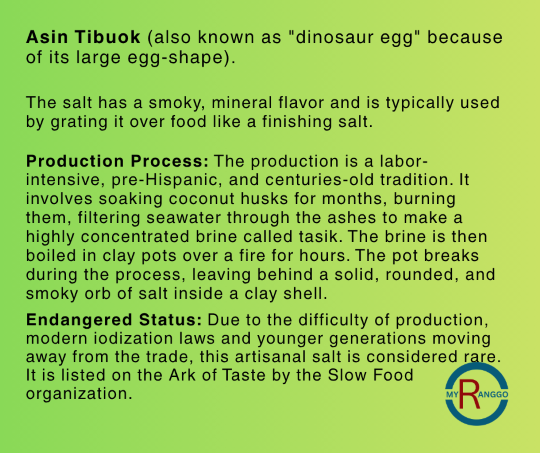
And then I have one ingredient which is always with me, wherever I am. I have it here [Melbourne] – Asin Tibuok.
It is known as the “dinosaur egg” and it is only made in a town in Bohol called Alburquerque. The process for making it involves using coconut husks.
These ingredients carry memory, he says They carry place
Food as Family and Community
Both chefs agree: Filipino food is emotional.
It’s not plated to impress – it’s cooked to be shared.
That belief shapes their Melbourne collaboration at the Melbourne Food & Wine Festival, one of Australia’s most respected culinary events.
Instead of a formal tasting menu they have chosen to host a Boodle Breakfast Feast – communal, hands-on, and designed for togetherness.
Using Australian ingredients with Filipino techniques, the experience invites diners into Filipino culture – not as observers, but participants.
Abi Marquez & Chef Morris’ Most Memorable Filipino Meals
Abi:
Top of mind is my visit to a province to the south of the Philippines, in Cagayan D’Oro. It was a learning experience for me and surprising.
We did a couple of [filming] spots there, and there’s a restaurant that serves heritage dishes – Cucina Higala. Anything on their menu with a logo of a horse is a heritage dish. I told the waiter “We’re ordering every Heritage dish”, because I wanted to learn about and taste all of those dishes.
Honestly, they were all those types of dishes where – even without a camera on you – you lean back and think “Wow! That’s amazing”.
One dish, the Suwan-Suwan, was a fried fish with a pineapple or mango sauce. It was super creamy and rich. I don’t know what they did, it was so good. I tried to recreate it, but it really wasn’t very successful. It was one of the best bites of my year, last year.
And then on the same trip we went to another local restaurant, Doy’s Isda sa Bato, which had Styrofoam ice boxes out the front with the catches of the day. The owner also owns a fishing boat and whatever they catch in the morning is what they’re going to serve in the restaurant throughout the day until it’s gone.
The menu listed the types of cooking techniques or kind of dish you could order.
It really showed me the difference of freshly caught fish. The fish, they explained to me, was caught and killed using a type of Pana – bow and arrow, and that it is the best way to retain the flavor of a fish. And I could really taste the difference – it was sweet, it was fresh, it was umami/ malinamnam.
And the vibe in that restaurant! It was full of big tables of uncles having beer – a very joyous vibe, very community, and the owner was very nice to us as well.
Both the food, experience and the vibe made that trip memorable.
When people ask me what my favorite, most memorable bites EVER are, it will always be those homey, hearty dishes.
Chef Morris:
For me, the best ones that I still remember – or that made me feel really good – is similar to Abi.
I remember when I was working – I was selling karaoke machines – and every lunch break we would go to this carinderia that was behind SM Pampanga. Before they gave you your order you would get this nice bowl of Bulalo soup, with a big bone, and the collagen, the beef and a really, really good broth, to warm you up.
And I always remember their Sisig Kapampangan too – because Sisig is from Pampanga and I hadn’t tried the real one until I worked there. It is really, really good and makes such a great dish.
If you think about it – it’s so simple with the flavors. It’s smoky, it’s umami with a little bit of chili, and the tanginess from the calamansi. That Sisig always made my day really special.
They also had a tripe Kare-Kare that was really, really good – but the best part was the sauce. It was not overpowering, the consistency was really good – just a perfectly balanced dish.
And this wasn’t a high-end restaurant; it was just a carinderia. They were really dedicated to the food that they cooked, so connected to the food – and so critical about their food.
That’s what I appreciated about them – so even until now, that’s the best experience I’ve ever had. More than any Michelin starred restaurant or a gourmet restaurant I’ve been to.
I still enjoy visiting and eating in restaurants, to learn. For me, it’s an art show where they present their food and techniques. Simple is the best.
A Cuisine Stepping Into the Spotlight
For years, Filipino food remained within Filipino communities.
Social media has changed that in recent years, with an abundance of food vlogs and self-styled Boodle-fight feasts filmed at home.
The Department of Tourism has also been working on raising the profile of Filipino food, and the culture and heritage behind the country’s famous dishes.
We asked why reels and posts about foreigners trying Filipino Food for the first time seem to do so well in terms of engagement.
Abi: I think Filipino food didn’t get much attention before, so when foreign tourists try it – we are really curious [about whether they will like it] and when they love it, it excites us.
And a lot of creators know this – there’s a thing called Filipino-baiting – so a lot more international creators are doing things like trying Filipino food for the first time, or talking about their favorite dishes, to get the attention of Filipino audiences.
And what I can see from comments is that Filipinos are very supportive of our culture and cuisine, and we’re a really, really proud people.
As more people discover Filipino food, something powerful happens: Filipinos see their culture reflected back – with pride.
Now we can show it to different audiences in every country, says Chef Morris.
—–
The Boodle Brunch will be held on March 28, at South Melbourne café Nine Yards.
With two sittings available, diners will enjoy a four-course communal feast that blends Filipino flavors with Australian ingredients.
Tickets for the Boodle Brunch are selling out fast but there may still be a few spots left via the Melbourne Food & Wine Festival website.
Did you miss Parts 1 and 2 of our interview with Abi Marquez and Chef Morris Danzen Catanghal? You can catch up here.